
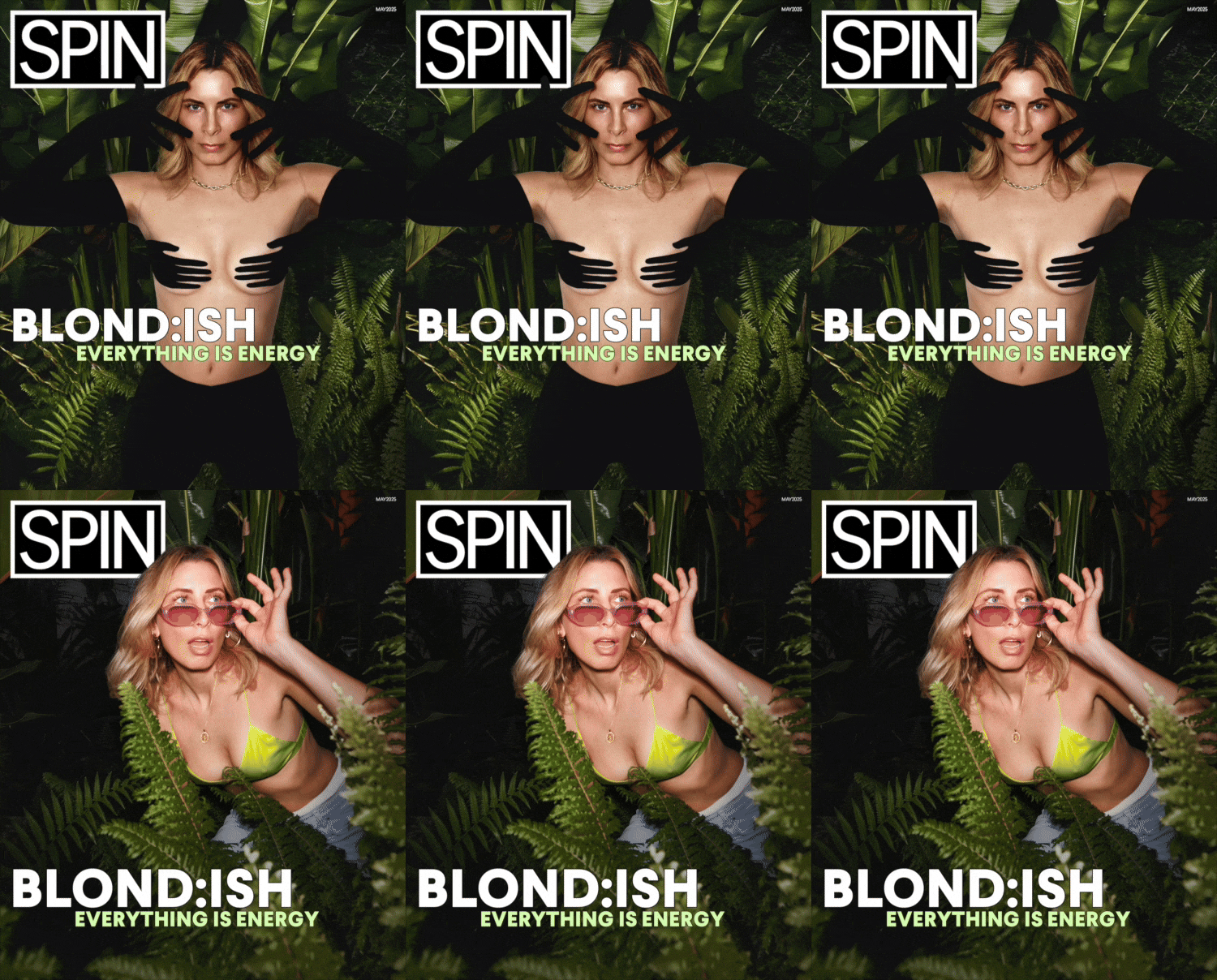
“My life is complete,” she says, when Joe’s Pizza requests her picture for their wall. She steps outside to “stamp” a guy’s white T-shirt with a slice, her signature blonde topknot glowing against the blue-dusk sky.
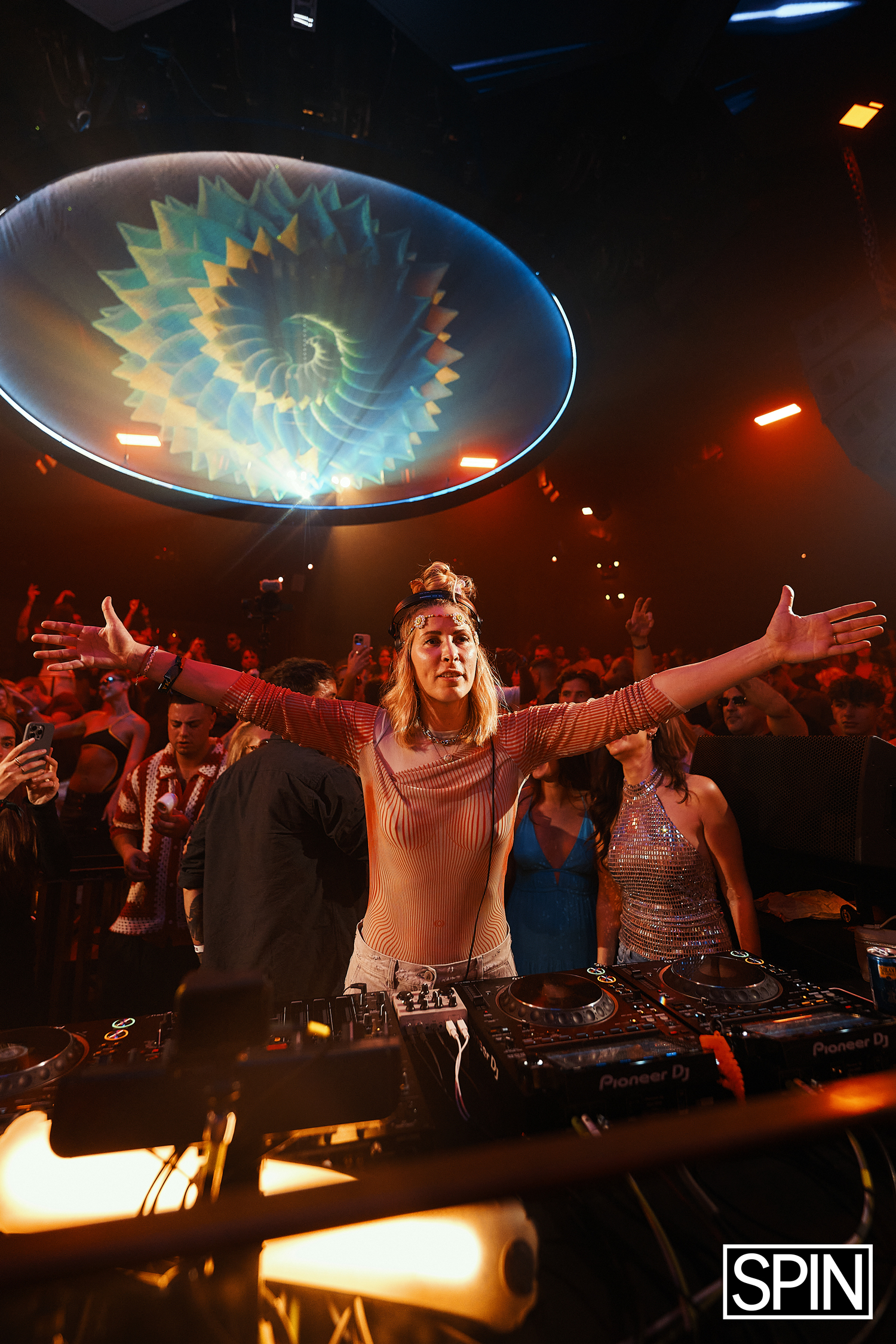
It’s all this and more that makes Bakos one of the most powerful women in the world of dance music today. BLOND:ISH built momentum through prolific releases and remixes, eventually reaching Bakos’ biggest goal, which was, in her own words: “Can I play for 10,000 people?” In the last couple of years she has appeared at Lollapalooza in Argentina, Brazil, and Chile, as well as EDC Las Vegas and Orlando, III Points Festival, and Coachella. She’s played on bills alongside Adriatique and even Madonna. Today, she’s a fine-tuned producer and in-demand remixer with reworks for Depeche Mode, Maya Jane Coles, and Born Dirty & Diplo to her credit. This year, her tour boasts stops at Outside Lands, Tomorrowland, Electric Forest, and, perhaps most significantly, her residency at Ibiza’s landmark Pacha nightclub—the first-ever female headlining resident in over 50 years.

BLOND:ISH first caught my attention because of the great name. The more I learned about BLOND:ISH, the more my opinion elevated. She single-mindedly leveled up in the male-dominated electronic music industry through sheer willpower coupled with on-point studio skills and thoughtfully curated DJ sets that put her and her audience on the same wavelength.
And here was an artist who didn’t just pay lip service to sustainability but launched a non-profit, Bye Bye Plastic, to help eliminate single-use plastics in the music industry. When she released her second album, Never Walk Alone earlier this year on eco-friendly BioVinyl and packaged in recyclable and/or compostable materials, I was keen to spotlight it.
BLOND:ISH not only schooled me on the benefits of BioVinyl and the non-discernable drawbacks in audio or physical quality, but also provided simple guidelines in Bye Bye Plastic’s Eco-Rider for her DJ colleagues to start moving toward a plastic-free DJ booth. Of this first step she said, “It’s a low lift, but at the same time, it gives everyone a taste of what it takes, and how to approach things with more circular thinking.” She also outlined guidelines for partygoers, encouraging them to exercise their online power, encouraging promoters to employ sustainable practice. “Make requests for things that matter to you,” she said. “There is power in numbers.”
Today, her hair is tucked behind her right ear, where it curls slightly under her jaw, signature darker roots contrasting with her “blondish” outgrowth. Her profile is all I see—and that’s all I will see for the next hour, as I speak to Viv from her home in Miami.
Quickly, I realize this is a different Viv, not the public, performative BLOND:ISH. This is the woman who is leaving for EDC Korea in a few days and the fun video from last September feels far different from this person who seems impatient and preoccupied.
If there was any misconception that she was larger than life, she is now undeniably human. She says that she “kind of got stuck [in Miami] during COVID,” one of America’s indisputably hottest (in every sense) cities. She was staying with friends, kind of “kidnapped” on a “compound with, like, three houses.” It was amazing, she tells me, of the “beautiful community” that grew from initial, friendly entrapment. “It was awesome,” she says, eventually admitting that it was also somewhat “lawless.”
This, in essence, describes the unique and secular world of the dance music community. The music has always attracted outsiders: those who are looking beyond the mainstream, who feel they didn’t fit in, who have deeper sensitivity, they found their people on the dancefloor. There, syncopated with the heartbeat of the drum machines, they connected on a cellular level with others who shared their thoughts and feelings, and perhaps the thrill of existing outside of societal convention, which, at times, might have verged on illegality—or full-blown criminal behavior—all for the love of the music. Once you make that connection on the dancefloor, be it in a sanctioned club or an unsanctioned warehouse, you are forever a part of that community, worshipping at the church established by the DJ.
While on the road, Bakos has some goals. “I have two different shows,” she says. “I have my headline shows where I'm playing for other promoters, and I don't really have control about the entire experience. I really try to make eye contact, but you can't make eye contact with everyone at the show. You can do the front row or certain moments. I can talk to people in my DMs after the shows, give that personal acknowledgement and attention. At my Abracadabra shows, I'll stand at the front of the door, and I'll hug every single person that comes through that door.

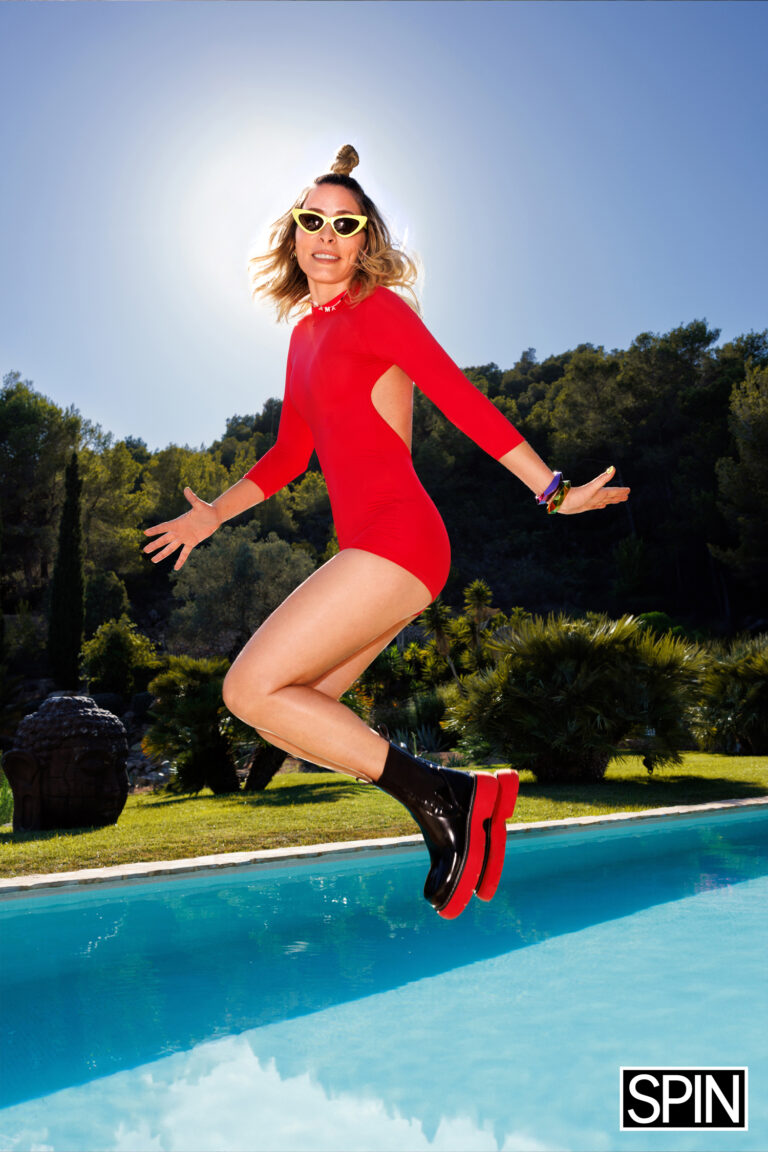
“It's a constant experiment and iteration, because I haven't figured out how to affect every single person at the party yet,” she says. Her ethos includes providing people with tools to live their best life. “[But] I feel like those things added up over time can affect the human race in a positive way, at least that's my goal. And I'm having fun doing it.”
A big part of Bakos’ plan is the “ecosystem” she’s built around her Abracadabra brand that encompasses events, record label, and shop, for which she is the figurehead. “We registered Abracadabra as a church in the U.S. because we want to share that our faith is magic,” she says. Bakos is crafting the church’s framework with the help of AI technology.
Which begs the question: What’s the prompt you give ChatGPT so it can build you a church?
“[ChatGPT] basically scraped the whole entire internet for anything I’ve ever said in my interviews, all the people I follow on YouTube, and put it in its brain,” Bakos says. “I’ve been working on it for months. I’m literally adding to it every day. You start a project in ChatGPT Plus, put it in memory, then say, ‘I want to build out the Abracadabra church, the ecosystem,’ and you keep adding all your ethos into that. The math of our ecosystem is 1 plus 1 equals 11. Everything is energy.”
Where the word “church” can sometimes have its own set of negative connotations, Bakos seems to base hers on her path of personal growth, steeped in mindfulness and positivity.
“I went on introspective trips where you learn a lot, not only about the human race, but also about yourself,” says Bakos. “When I started meditating, doing a lot of breath work, I realized my journey with music is much more than an ego thing. I’m obsessed with learning. I’m obsessed with music. How can my experience turn into value for my audience through my music?”
Bakos incorporates daily rituals: sunrise and sunset viewings, daily meditation—particularly an abundance practice (“it’s my mantra, it changed my life”)—and tai chi. She mentions Chiva-Som, the holistic health and wellness resort in Thailand where, she says, “You rehabilitate and become superhuman.”
This carries into her diet. Bakos—who lives with her partner Liana (who helps run Abracadabra) and their infant son—follows a high-protein, low-carb, gluten-free diet.
Before each DJ set, Bakos performs a 5-minute qigong ritual to generate an energy field around her. “I’m always trying to have optimal focus, attention, and energy for everyone else, because it's all I talk about,” she explains. “That's all people see from me and from my shows, is my energy, so I need to keep my energy at top form.”
Abracadabra events mirror this. “Everything is there for your discovery,” Bakos says. “On the surface, it’s a party. If you want to go deeper, you can. I found that’s the best way to approach everything because otherwise people will judge you, or they might not pay attention. I want to approach it in that familiar way, so people discover it like kids. Then they’re on their own journey.”
This insight—people respond better to discovery than preaching—was crystallized through her work with Bye Bye Plastic. “Everyone has their own relationship to the plastic issue,” she says. “Some people could care less; some people are really focused on it. When we went through the process of, ‘how do we make festivals plastic free,’ and the different people we needed to deal with, that's where I understood you can't change human behavior by telling them facts.”

Bakos wants to make sure we talk about her high-profile residency at Pacha which starts May 21. But she won’t reveal any plans other than telling me her team will integrate into the crowd offering bracelets, a trick she picked up from Swifties, and working with mentalists who roam the room levitating coins.
“If I tell you everything, it’s not really discovery,” she says. “We’re here to show you how you can create your own magic.”
Bakos explains the 432 Hz to 532 Hz frequency range is what her audience responds to most favorably. When I ask how she came up with those numbers, she talks about sound meditation, experimenting with mushrooms, going to Tulum, being into Eastern practices, hearing more notes in the scale, more detail in sounds.
“I’m just obsessed with sound,” she continues. “My journey around sound and music brings me to all these experiences.
“Everything is energy.”
Bakos says she transfers this energy to her audience. But as her profile grows and her time becomes limited, she channeled the energy into Never Walk Alone.
“Everything is here, but not everyone has that highway or channel open to them,” she says. “Life is a video game. You acquire tools along the way so that you can deal with anything. Never Walk Alone is that tool.”
Moby was an early follower. He stumbled upon an early BLOND:ISH production on Beatport and says he “fell in love with it, which is saying something as there are so many dance tracks being released every second of the day, it’s unbelievably hard to create something that stands out.”
He invited Bakos to remake any song from his catalog. She chose “Natural Blues.” “I feel ‘Natural Blues’ is a song that all ages would still love. It's this cross generational song that I wanted to redo,” Bakos says.
Moby co-produced the remake (which releases May 30 via Defected) with Bakos and her friend Kiko. Says Moby, “One of my favorite things about the world of remixing is when they send me their new version, it’s like Christmas morning, and I get to hear how someone has used their creativity on a piece of my music.
“What really struck me was how masterfully she melded the emotion and melodic qualities of the original with cutting edge production that puts it firmly on dance floors in 2025.”
Bakos is no stranger to high-profile reimaginings and remixes. She collaborated with Madonna and remixed Taylor Swift’s “Fortnight” (feat. Post Malone), giving it a euphoric twist. “Her music is so far away from mine,” she says of Swift. “I'm inspired by her as an artist more than her music. The irony is that my brand is about positivity and energy and happiness, and then I get this sad song to remix. I was like, ‘How do I turn this into a ‘crying in the club’ type of song? It was a fun challenge.”
Bakos is building an “Abracadabra marketplace empire” on TikTok, an extension of Abracadabra. Abracadabra even has its own currency—$ISH—which you can earn by doing things like working on yourself or dancing at Abracadabra parties. These tokens unlock discounts and rewards across the ecosystem—from the church to the label to the shop.
“Earning tokens turns into energy for the ecosystem,” she says.