
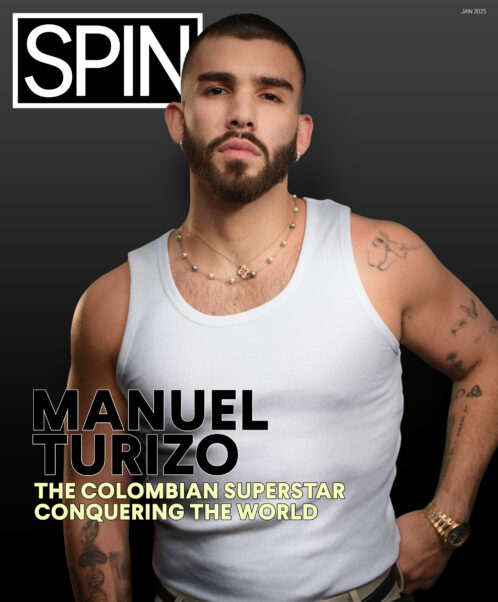
You could say the same thing about Turizo’s career. At 24, he’s a three-time Latin Billboard Award-winner and was an honoree in Variety’s “Power of Young Hollywood 2024.” His 2023 hit song “La Bachata” became the No. 1 most-streamed Latin solo song in Spotify history last year, earning him 26x Latin Platinum status and U.S. Platinum certification. He has appeared on The Tonight Show with Jimmy Fallon and performed in the Macy’s Thanksgiving Day Parade (and the NBC Rockefeller Christmas Tree Lighting!).
Turizo’s rapidly growing impact goes beyond music. In the fashion world, he’s worked with brands like Fendi, Dior, and American Eagle. During our interview, he wears a black Eme Studios Club ball cap that sits atop his shaved head and silver hooped earrings in each ear.

He shows me some of his other tattoos—a double helix, a dopamine pill, a CD—all representing his first three albums: ADN (the Spanish abbreviation for DNA), Dopamina, and 2000. He has yet to get ink for his fourth album, 201, released last November.
Turizo is in Spain, where he’s taping the 10th season of La Voz Kids (part of the internationally syndicated franchise The Voice), the Spanish music competition show for kids, on which he’s a coach.
He seems to end every sentence with a smile, his arms outstretched across the back of his chair, perfectly relaxed. He’s charming, charismatic, and personable, which, besides his smooth tenor voice and genre-defying musicality, made him an international sensation. Being able to sing in English, Spanish, French, and “whatever is needed,” he says, doesn’t hurt, either.
Manuel briefly considered becoming a veterinarian when he was a child due to his love for animals. But watching his father and older brother, Julián, play guitar, he quickly felt the pull toward music.
“As a kid, you start trying to do the same things that you see the older people in your house and your environment [do],” he says, speaking perfect English. “When I turned 12 years old, I wanted to get lessons about how to sing, how to sing correctly, you know? I used to sing, but everybody can sing in the bathroom, like not in a good way. So I wanted to learn correctly.”
Columbia is the third-largest supplier of beef in Latin America and the Caribbean, most of which comes from the small working-class town of Montería, where Turizo grew up. There, cattle graze lazily on acres of farmland while planchones — covered rafts — shuttle passengers across the Sinú River to Ronda del Sinú Park, where iguanas, monkeys, and sloths roam. The sunsets are incredible, he says. “In Montería we say this Caribbean phrase, ‘bajo sin nu,’ which basically means ‘without a penny,’ because we can have no money and still be so happy to be alive in such a beautiful place,” Manuel tells me.
Twelve-year-old Turizo found a vocal coach and begged his parents for classes. They agreed to pay for two lessons if he got a job and helped pay for the rest. So he sold hats, bags, cellphones, and other items. “That was the moment where I started writing songs about that time of my life.” It was also the moment when he started thinking about his future, what he wanted to be, and his place in the world. “When you are a teenager, I feel like you are trying to look out where your place is in the world, you know, where you came from. I found mine in the music.”
Accompanied by Julián on guitar, ukulele, and vocals, Turizo began making music, releasing his first two singles, "Vámonos" and "Baila Conmigo" in December 2016. But it was releasing his third song on YouTube, "Una Lady Como Tú,” at the age of 17 in March 2017, that catapulted his career, going viral with 300 million views (now almost 2 billion) and ranking in the Top 40 of the Hot Latin Songs chart.
Soon after, he signed with La Industria Inc., a Sony-distributed label, and opened for Puerto Rican singer-songwriter Ozuna during his 2017 Colombian tour, before touring on his own and selling out all of his own shows. “Achieving success at a young age made me happy, being able to get up and do what I like,” he tells me. “It’s a blessing. I am living my path of happiness.”
Over the next two years, he released a slew of singles, including a collaboration with Ozuna on “Vaina Loca,” for Ozuna’s second album, Aura, which became Manuel’s first to chart on the Billboard Top 100 — and one of the first songs to reach 1 billion views on YouTube.
Other singles like "Esperándote" and "Una Vez Más" with Puerto Rican rapper Noriel, eventually culminated in his 2019 debut album, ADN, which soared to No. 8 on the Top Latin Albums chart. A star was truly born.


In 2021 Dopamina, hit No. 15 on the Top Latin Albums chart.
Up to this point in his career, the Columbian singer-songwriter had experimented with a variety of music genres—reggaetón, vallenato, trap, and even R&B. But when he decided to create a new song based on the Bachata—a Dominican style, acoustic guitar-infused style with Spanish, African, and Taino elements—using electronic riffs and R&B vocals, it was a risky move. Released in May 2022, “La Bachata,” became his biggest hit to date.
“If you don't try different things, you're not going to get what you’re looking for,” he says.
His third album, 2000 — 23 years out of synch with its title — in 2023, includes collaborations with Argentine singer Maria Becerra on "Éxtasis", and Marshmello on "El Merengue,” and ranked No. 11 on the Top Latin Albums chart. Turizo also collaborated with Shakira on her 2023 single, “Copa Vacía,” and made it into her mermaid-themed video.

“Every day is like trying to challenge myself to see how I can get better, how I can do my best and how I can improve what I know,” he says. “I see it as a game. You try and just be better every day, you know? I have the blessing, thank God, to be doing something that I love to do.”
Beginning with Gloria Estefan in the 1980s and Jennifer Lopez, Ricky Martin, and Shakira in the ’90s and 2000s, a new generation of musicians such as Bad Bunny, Karol G, Peso Pluma, and, of course, Manuel Turizo, are enjoying crossover fame in the U.S. According to a study released last year, Latin music listenership had increased by 15.1% over a year with almost 51 billion streams by June 2024, outpacing rock, pop, gospel, and country. That makes Latin music the fastest-growing genre on U.S. streaming platforms.
I ask him how he feels about this current surge of Latin music in the U.S. He tells me it’s both incredible and brutal — I assume he means his relentless work schedule. Now that he’s living in Miami, he’s witnessing it firsthand. “I love it,” he says. “It fascinates me and I hope it’s the same with my music. And we have to learn, internalize, evolve, and try new things, make a new, happy, and content world.”
In November 2024, Manuel released 201. Named after the apartment unit he grew up in as a boy, the 12-track album showcases a mix of Latin rhythms and urban beats. It was important for him to transport listeners to the simplicity and beauty of his hometown during his childhood.
“I wanted to make it feel like you're in my city, in Montería, in the Caribbean,” he says. “I wanted people to feel like how it would sound if I take you to a party with my friends where I'm from, what I like to listen to, how it would be.”
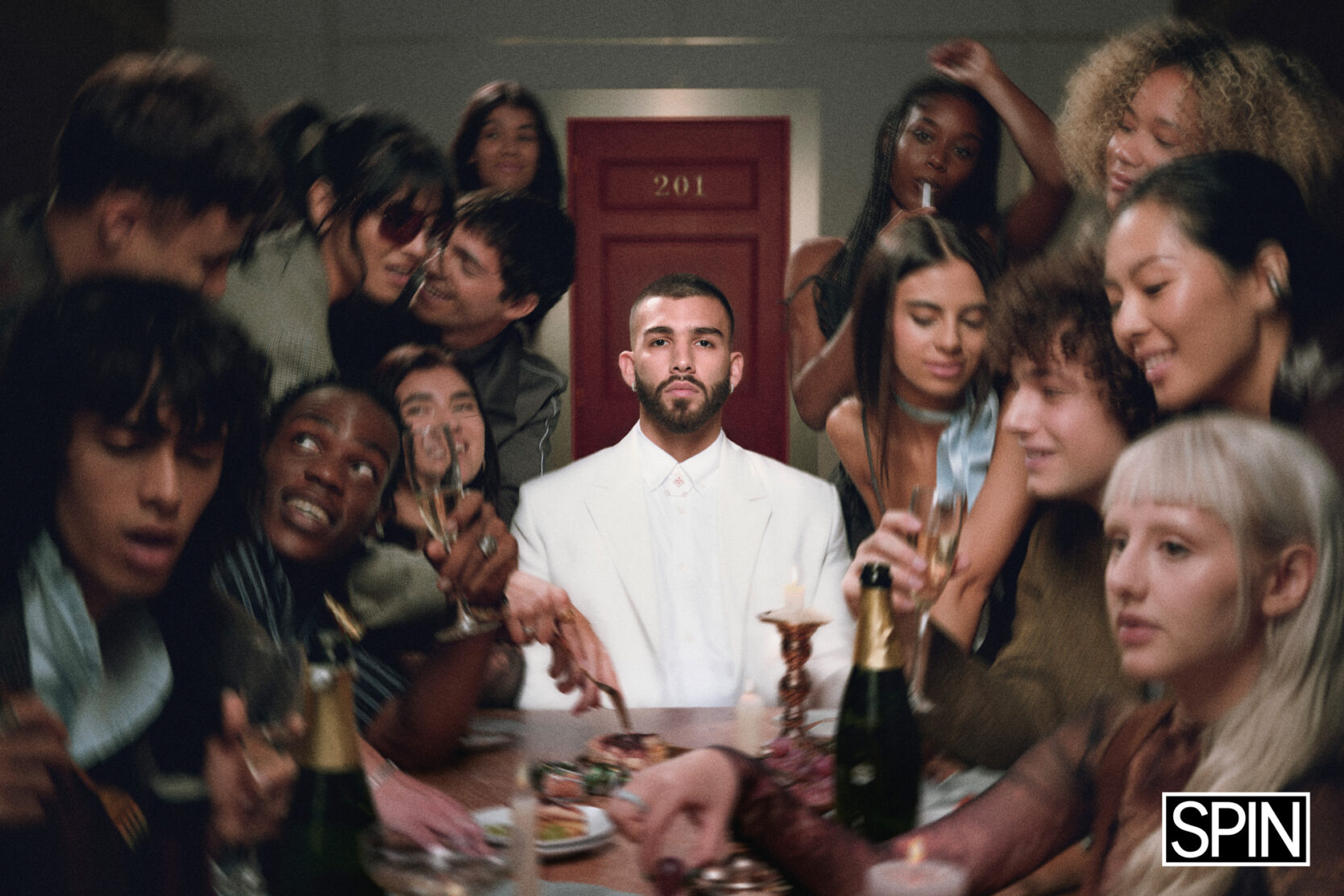
His childhood apartment number on the album cover is more than an identifier of rental space, he says; it’s a testament to how far he’s come. “It's where my life happened, where all the bad and the good things happened.” The idea, he says, is for people to listen to the album in their own places, with their families and the people they love, and to make memories. The release date of the album was intentional as well, right before the holiday season when families and friends get together to enjoy each other’s company.
“It's about being with your people, to enjoy with your people. It's being happy. It's just being chill with good vibes,” he says. While each track is different, he says, the overall vibe is the tropical flavor of the Caribbean. “In Colombia, I feel we love to party, we love to be happy.”

Manuel never thought music would lead him to become one of Columbia’s biggest music sensations since Shakira. “I just wanted to do something that I really love to do,” he says. “I didn't know anything else. I didn't know how far you could go on this. I didn't know anything about the music industry. I just knew that I liked the music.”
He says what he really holds dear is his family, who were his first supporters. Julián, who helped him launch his musical career, is still his musical partner. In fact, he composes most of Turizo’s songs.
His roots lie, he says, not in where he geographically came from, but who he came from. “Where you come from is your DNA… and that is everything,” he says. “In the end, we are what we are taught.”