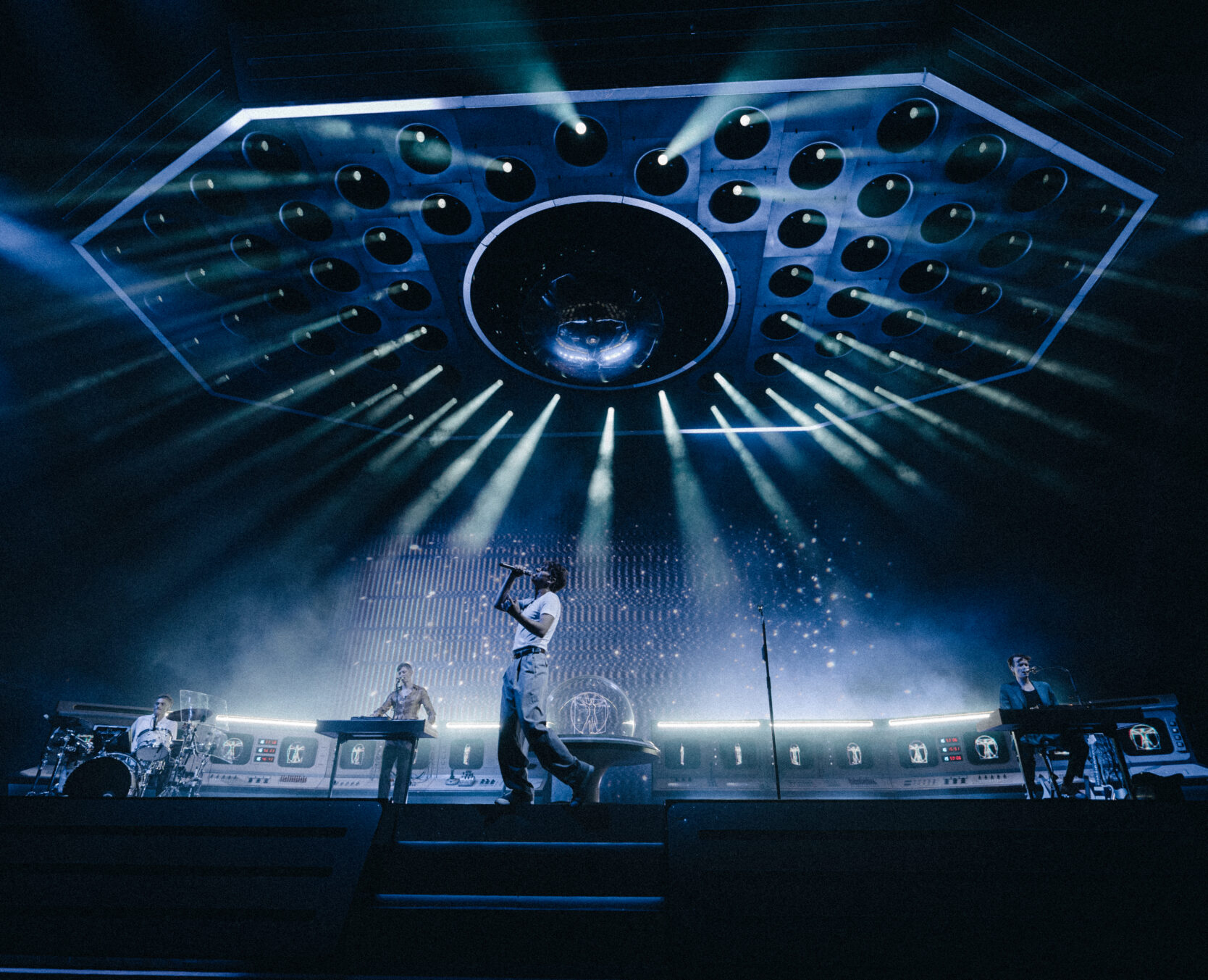
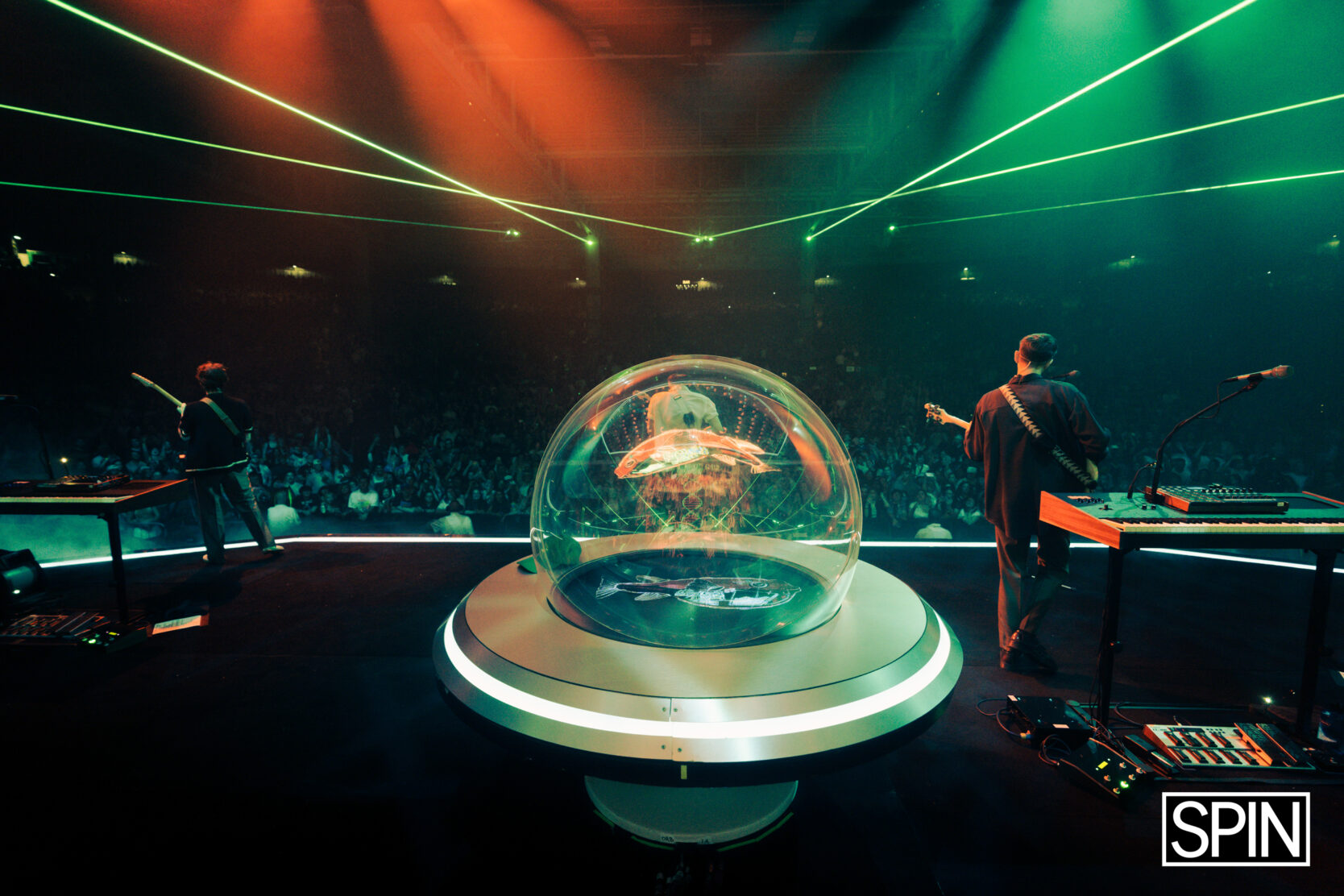
On a rising pedestal that appears on the back of his space-station stage setup, from which he glances nervously off stage to the crew, silently begging them to make his mic and guitar work while he keeps the “nobody panic” composure necessary for the captain, Bayley is by himself.
In space, no one can hear you scream. Because the mic isn’t on. And the bouncy, technicolor indie-rock dance party has come to a halt for the time being.
All of that stage decoration is meant to give off the impression of retro-futuristic space-age technology. And in this moment, the technology fails him. He’s drifting, praying that the mission control crew below can make his machines work again and bring him home. You can almost picture them nervously chain-smoking cigarettes and pacing the room waiting for a bit of good news from Bayley to crackle through the system.

The crowd below is patient, and cheers and claps with him nonetheless—even starting what has become a mandatory thing in this town whenever there’s a lull for more than a few seconds:
“E-A-G-L-E-S, EAGLES!”
As if like magic, the mic is once again hot and the guitar is amplified.
“We’re back in business,” he says with almost Fonzie-like (or maybe Jim Lovell-like) cool and reassurance. Just like he planned it.
Bayley smirks now.
“That’s how you know it’s real.”
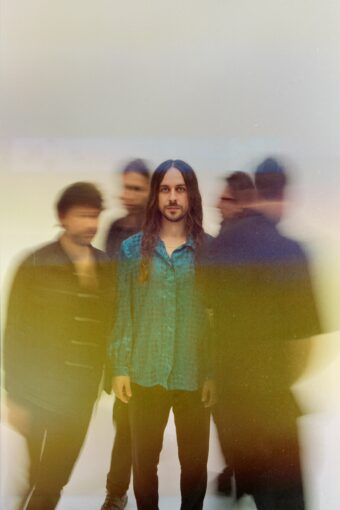
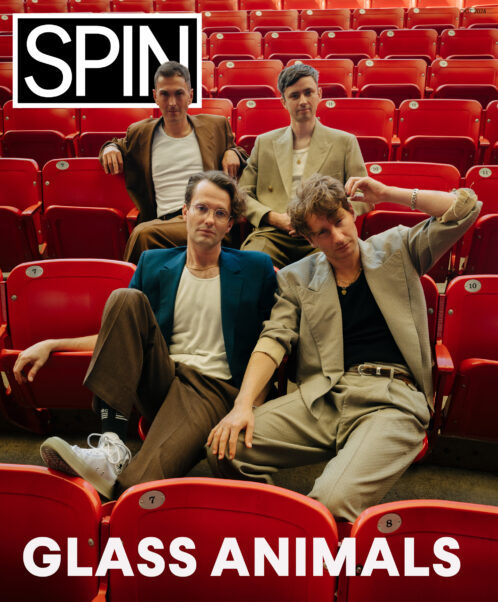
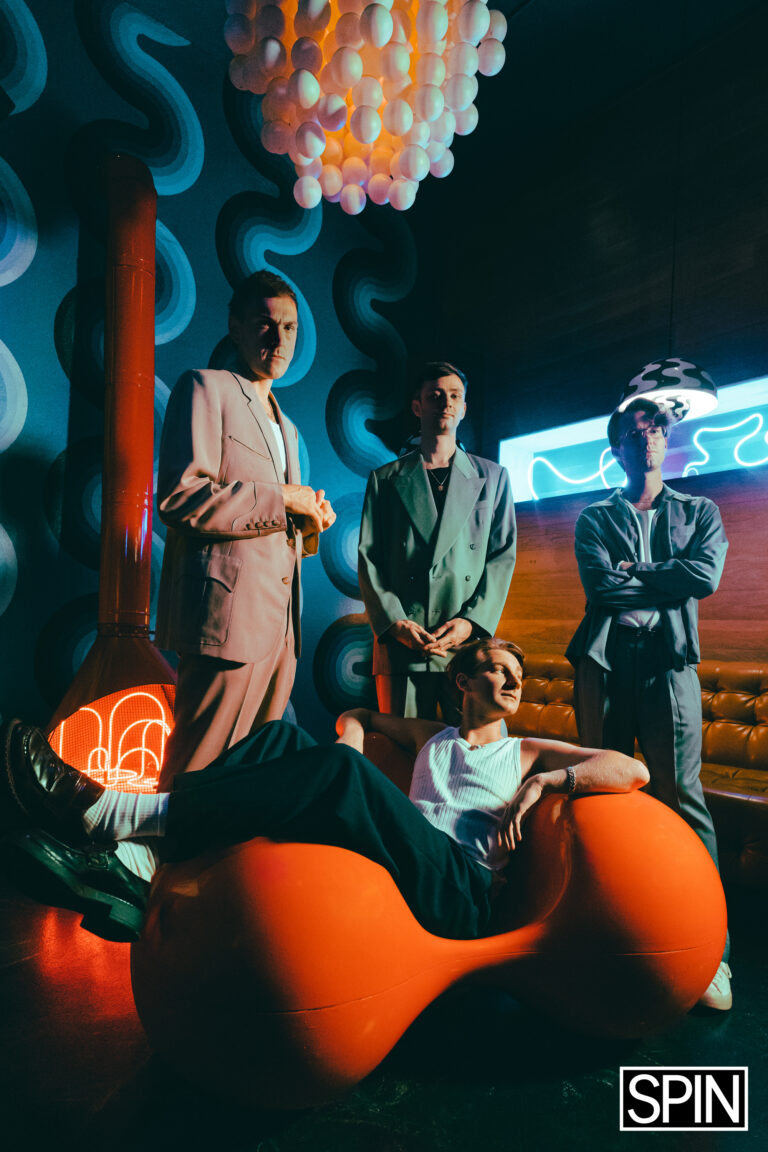
Bayley’s career as the creative engine of the nimble, poppy, genre-line-blurring Glass Animals often leaves him feeling like he’s in space—both in good ways and bad. The Oxford four-piece—rounded out by Joe Seaward (drums), Edmund Irwin-Singer (bass, keys), and Drew MacFarlane (guitar, keys)—have known each other since their school days, and they’re as close to brothers as friends can be. That resilience as a crew has been tested time and again—through stardom, pandemics, and even very-real near-death experiences.
Bayley knows his duty as the frontman of the operation, though. During live performances, he only stays in one place for extended periods when absolutely necessary. He doesn’t even stay on the stage if he has to, exploring the back lawns of the venues and testing the limits of the cordless tech and the venue security staff. He knows how to elicit a roar from the crowd—maybe it’s introducing a song title, maybe it’s taking a minute between verses to groove about the stage, and maybe it’s declaring it’s too warm for the baggy suit jacket and tossing it aside in favor of the more breathable and revealing tank top underneath, as if that wasn’t the plan all along. He’s sort of a family-friendlier Matty Healy, with all of the characteristic English indie rock frontman boyish charm, but with a haircut that you could set your watch to.
Hell, his first career path in college was to be a doctor.
But the rock star dreams were always there. Really, Bayley says it was more of a compulsion to make music than a career decision.
Glass Animals’ trajectory was what Bayley called “two years of overnights, a lot of long nights,” as opposed to an overnight success. For the most part, it followed the Successful Indie Rock playbook to the letter: a FIFA soundtrack placement here, some late night TV appearances there, some festival spots thrown in for good measure.
But in 2018, two years after releasing their second album, How to Be a Human Being, Joe Seaward was hit by a truck while biking in Ireland, which obviously meant putting tour dates on hold while he recovered from multiple surgeries and learned how to walk, speak, and read again—to say nothing of playing the drums in an actively touring rock band.
“We’ve had a few things thrown at us, a drummer nearly die, all sorts of stuff,” Bayley says, a few hours before the band takes the stage in Toronto. “There’s a lot of luck in music, and a lot of working very fucking hard. And if the two align, things can happen. We were lucky—we worked really fucking hard, and it’s been amazing. It has been a journey. Even after that first album, there have been moments where I’ve really thought the project was done because the bad luck had hit.”
Seaward thankfully made a full recovery, and the band’s luck got back on track when “Heat Waves” hit as a single from 2020’s Dreamland. And boy did it hit. The song spent 91 weeks on the Billboard Hot 100 chart, breaking the Weeknd’s record for “Blinding Lights” and becoming only the second U.K. band after the Coldplay Hit-Making and Entertainment Corporation to top the chart in the 21st Century. “Heat Waves” even became a TikTok staple for a spell, launching Glass Animals into the stratosphere.
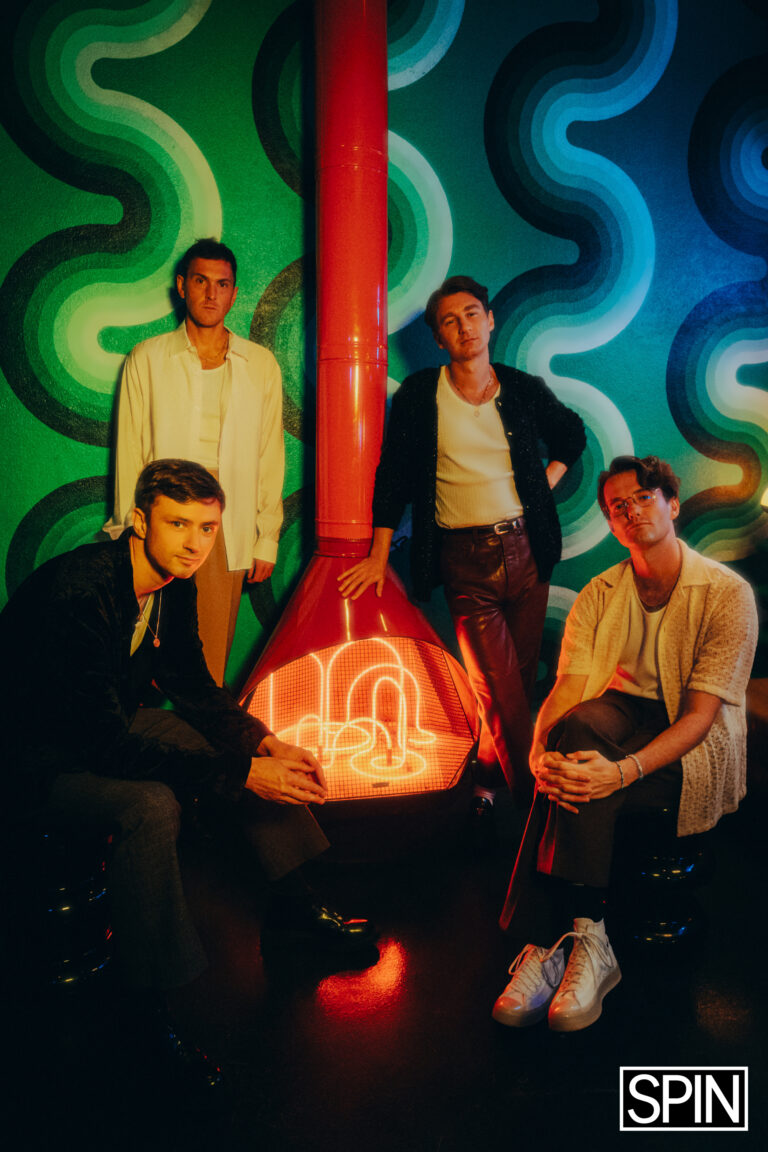
But all of that happened in June 2020, when everything—all of that fame, all of the success, all of the new fans eager to hear their new favorite song—had to be viewed from a distance, as if through a porthole in the metaphorical ship.
I don’t need to remind anyone what the world looked like for most of 2020 and 2021. Eventually, when we got to that often-quoted “new normal” where bands could tour with heavy caveats, Glass Animals were able to connect with their newly leveled-up fanbase to some socially distant degree. But the thing with touring during a massively surreal time is that it still feels pretty surreal—even more surreal than becoming one of the biggest stars in indie rock, one would imagine. It came with the fear and knowledge that two blue lines on a test strip from anyone in the touring party would bring it to a very expensive halt.
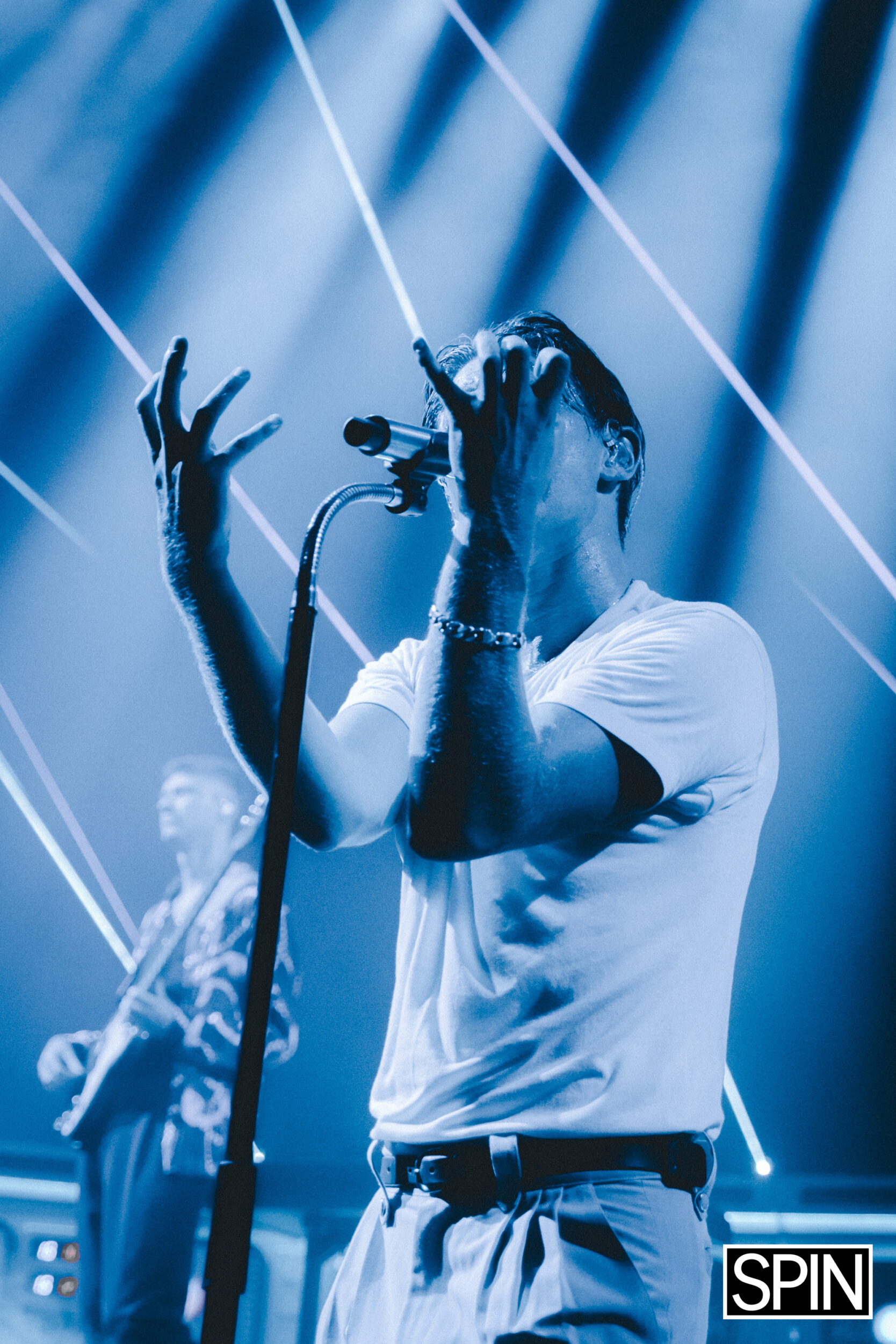
“We kept isolating while we’re on tour. Out on stage, back in the bus,” Bayley says. “It was a bubble. A tiny little bubble. Just the four of us and our tour manager. Even the crew were separate. Really strange time. Still felt this dissociation from reality. Go out and have this amazing hour and a half where you really feel the warmth and you see the result of all of this stuff, and then you’re back in the tour bus, and you’re like, ‘Was that a dream? What the fuck just happened?’”
Following the blow-up of Dreamland, Bayley headed to the West Coast to do some writing, both for himself and others—including Florence Welch, contributing to her 2022 album, Dance Fever. A Londoner in the rare moments he’s not touring or working, he found what he called “a real steal” of a studio-like house on stilts looking over the Valley.
Something about Dave Bayley on tall platforms, man. The guy doesn’t have the best luck up there.
“Got there and realized, ‘Yes, this house is … is … it’s not for everyone,” he says diplomatically, probably not wishing to offend the home’s owner. “Stilt houses are kind of beautiful, and they’re a feat of engineering, but they sway in the wind. And every time you look out the window you’re looking at a mountain cliff. That’s where I was at. I got used to that, but then this storm came in that just sort of took it to another level. The storm came in, and I came down with … I think it was COVID, and I wasn’t going anywhere any time soon.”
With the wind and rain ripping against the house precariously placed above the cliff, Bayley thought he was facing the end. Like, the end end. He mustered all of his COVID-weakened strength and pulled his mattress as close as he could to a doorway that was actually attached to solid ground, just in case he had to bolt at a moment’s notice.
“It was a couple of days of really heavy, heavy sickness,” he says. “And then what was going through my head is ‘Death is certain.’” It wasn’t—the clouds cleared up eventually. “It was a bit like how I imagine coming out of a bad trip or something,” he says. “It just felt like, ‘Whoa, I’m alive. This is kind of wonderful.’”
Back in that moment of uncertainty, in the house on the cliff, Bayley harnessed that unease and did what he had done his whole life, even before the fame and the hits and the big crowds—he fiddled with his guitar to make sense of his life. Music, he says, is how he’s always grounded himself. And now that he’s spending a lot more time above the ground, that’s important.
“I was still kind of sweating huge amounts of liquid out, getting that virus out of myself,” he says. “I had a guitar and a little recording rig, and that’s when I started making some music because that’s the safe place.”
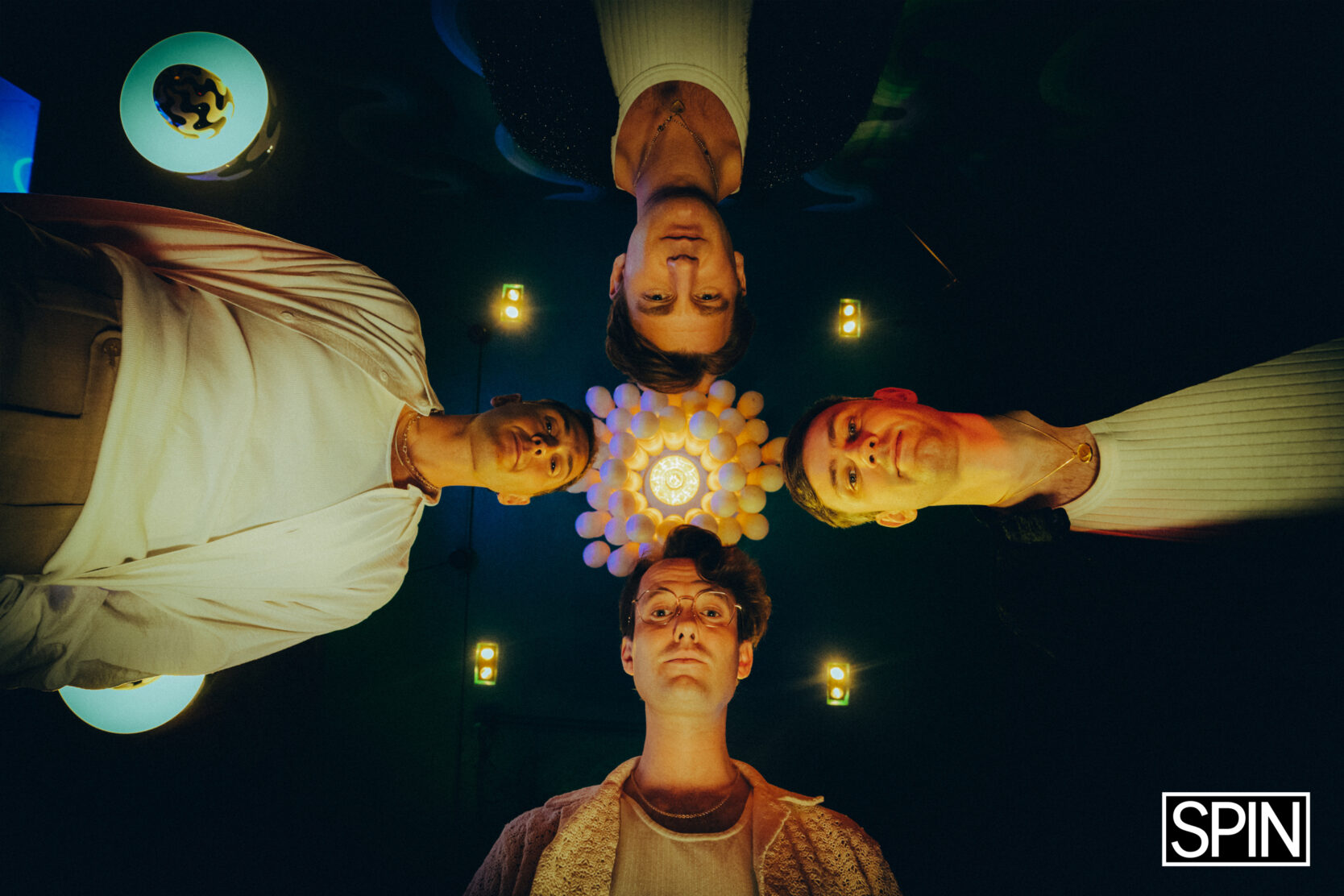
Those first sessions yielded demos for what he calls some of the “existential” and “doomy” songs—including “Creatures in Heaven” and “White Roses”—from July’s I Love You So F***ing Much. It’s an album that exists, as Bayley has so often, both in isolation and in community. What started as “spacey” and existential soon gave way to a more hopeful vibe.
“And then as I started to see the light and find a bit of hope, I started doing more grounded and more earthy-sounding [songs], like “On the Run,” and “Lost in the Ocean” came a bit later in the process.”
The final album covered a lot of territory, sonically and thematically—from groovy explorations of the thrills of being kidnapped in “whatthehellishappening?” (“And if I survive, if I survive, I'll do this again every summertime”) to anthemic, bitter ballads like “I Can’t Make You Fall In Love Again” (“That's just one more thing about you / I don't need in my life”), finally setting on the duplicitous start-stop of “On the Run” (“Somehow I find every time / that I shit the bed anyway / The Internet said, Internet said”) and the soulful waltz of “Lost In the Ocean.”
These songs explore finding thrills in danger, feeling alone by choice or by force, feeling lost, running away from your self-doubt or literal criticism—they all might be fictional stories, or they might be proxies for the very real situations that Glass Animals have found themselves in over time.
Once those ideas started flowing, Bayley did something really weird. The same house that he feared would blow over like a toothpick statue in a storm? He decided he wanted to stay. He was onto something with these tunes, and this seemed like the place to solidify those ideas.
“It’s a beautiful house, and the view from it is amazing,” he says. “You can see the whole of the valley. And it’s so high up that you feel like you can see the curvature of the earth almost.”
Part of Bayley’s grounding experience—from his ascent to the tragedies within the band and on society overall during COVID, to now being in a lighter space, professing to his listeners how much he loves them so fucking much—was using that sense of dread, of understanding that everything can disappear in a snap, whether it’s in a house on stilts, in a tour bus, or on a bicycle. He chose to lean into it rather than run from it.
Why didn’t he do what a lot of other people in his position would’ve done after his near-death experience: get the fuck out of there and hole up in one of the many terrestrial hotels and homes in Los Angeles?
He answers this question, as well as the subtextual question that I might not have realized I was asking, which is why they still managed to stay the course?
Why not just fall back on the perfectly reasonable plan B of being a doctor?
“Well, when the weather cleared up, I was like, ‘If the house didn’t go down in that, we’re good.’”